|
Charles Hodge
(1797-1878AD)
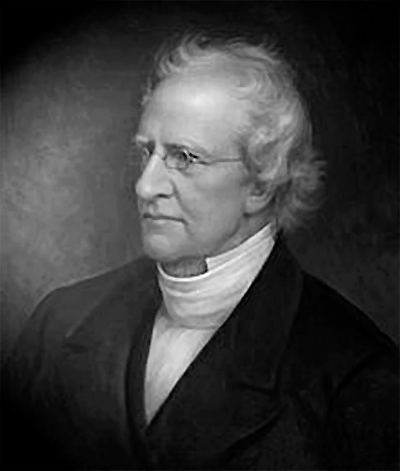
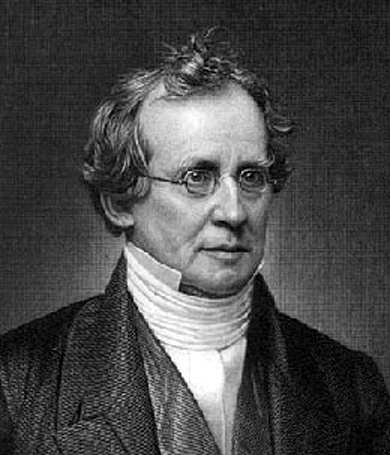 CHARLES HODGE, an American Presbyterian theologian, was ordained in 1821, and taught at Princeton for almost his whole life. In 1825 he founded the Biblical Repository and Princeton Review, and during forty years was its editor, and the principal contributor to its pages. He received the degree of D.D. from Rutgers College in 1834, and that of LL.D. from Washington College, Pennsylvania, in 1864. In 1840 Dr. Hodge was transferred to the chair of didactic theology, retaining still, however, the department of New Testament exegesis, the duties of which he continued to discharge until his death. His most important works are his commentaries on Romans (1835), Ephesians (1856), 1 Corinthians (1857), 2 Corinthians(1859), as well as Constitutional History of the Presbyterian Church in the United States (2 vols., 1839-40), Systematic Theology (3 vols., 1871-3), and What is Darwinism? (1874). He was an outstanding defender of Calvinism, and has a claim to be considered one of the best theologians and Bible commentators America has produced. “Dr. Charles Hodge was a man of warm affection, of generous impulses, and of John-like piety. Devotion to Christ was the salient characteristic of his experience, and it was the test by which he judged the experience of others. Hence, though a Presbyterian and a Calvinist, his sympathies went far beyond the boundaries of sect. He refused to entertain the narrow views of church polity which some of his brethren advocated. He repudiated the unhistorical position of those who denied the validity of Roman Catholic baptism. He gave his sympathy to all good agencies. He was conservative by nature, and his life was spent in defending the Reformed theology as set forth in the Westminster symbols. He was fond of saying that Princeton had never originated a new idea; but this meant no more than that Princeton was the advocate of historical Calvinism in opposition to the modified and provincial Calvinism of a later day. And it is true that Dr. Hodge must be classed among the great defenders of the faith, rather than among the great constructive minds of the Church. He had no ambition to be epoch-making by marking the era of a new departure. But he has earned a higher title to fame, in that he was the champion of his Church's faith during a long and active life, her trusted leader in time of trial, and for more than half a century the most conspicuous teacher of her ministry. The garnered wisdom of his life is given us in his Systematic Theology, the greatest system of dogmatics in our language.” Francis L. Patton (from Schaff-Herzog Encyc. of Religious Knowledge)
SYSTEMATIC THEOLOGY (1873AD) 1. The Protestant Rule of Faith. (244k) pdf (144k) docx (56k) 2. Infallibility of the Church. (86k) 3. For Whom did Christ Die? (58k) 4. The Divinity of Christ (1) (69k) 5. The Divinity of Christ (2) (41k) 6. The Divinity of Christ (3) (86k) 7. The Holy Spirit. (59k) zip (17k) 8. Roman Catholic Rule of Faith(1) (128k) 9. Roman Catholic Rule of Faith(2) (100k) 10. The Plan of Salvation (182k)
TRACTS, SERMONS, ARTICLES & BOOKS 1. Memorial Service sermon for J. W. Alexander by Charles Hodge 1859AD (39k) 2. What is Presbyterianism? (221k) an address in 1855AD pdf (138k) 3. Reunion of Old & New Schools of Presbyterian Church. (243k) reprinted from Princeton Repertory, 1867AD pdf (184k) 4. The Great Revival of Religion, 1740-45.( 729k) from The Constitutional History of the Presbyterian Church in the USA. pdf (426k) 5. Arminianism and Grace. (248k) an article from "Princeton Review" (January, 1856AD) reprinted 1881AD in Canada. pdf (81k) docx (60k)
|